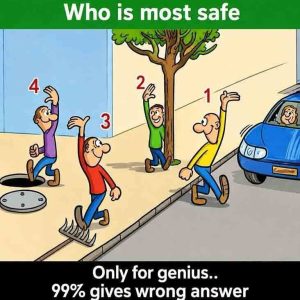
Visual puzzles often seem easy until we start examining every little detail. In this illustration, four people are positioned near different objects, and the challenge is to decide who appears safest. Person 1 is walking close to a moving car, creating a possible collision risk. Person 3 is approaching a rake lying on the sidewalk, which could cause a painful accident if stepped on. Person 4 is standing dangerously close to an open manhole, presenting a potentially serious falling hazard. Each situation requires caution, but one person appears to be facing fewer immediate risks than the others.
The intended answer is Person 2, who is standing beside a tree. Unlike the other three people, this individual has no obvious immediate hazard nearby. There’s no moving vehicle beside them, no gardening tool directly in their path, and no uncovered hole at their feet. Some viewers might argue that a branch could fall from the tree or that the tree itself might be unstable. However, the picture provides no evidence that either event is about to happen. The puzzle encourages viewers to focus on visible dangers rather than inventing possibilities that aren’t supported by the illustration.
Interestingly, the exercise also highlights how differently people assess everyday risks. Someone who has experienced a traffic accident might immediately notice the moving car. Another person may focus on the rake because they’ve previously tripped over something similar. Others may consider the open manhole the greatest danger because a fall could have serious consequences. These differences don’t necessarily indicate intelligence or personality. They simply show that our experiences and attention can influence what we notice first. A single cartoon puzzle cannot scientifically measure someone’s intelligence, but it can encourage careful observation and logical thinking.
The bigger lesson is that recognizing danger often begins with paying attention to our surroundings. In everyday life, simple hazards such as loose rugs, gardening tools, uneven sidewalks, and moving vehicles can cause avoidable accidents. Taking a moment to look around before walking or crossing a road can make a difference. The safest person in the picture isn’t necessarily guaranteed to remain safe forever, but based on the visible information, Person 2 faces the fewest immediate hazards. Sometimes the correct answer really is the simplest one, even when our minds try to make the problem more complicated.
What was your FIRST answer — 1, 2, 3, or 4? Did you choose Person 2, or did something else catch your attention? 👀



This Post Has One Comment